Rethinking Helpdesk Automation with Agentic AI


Helpdesk's automation has long relied on rules and workflows, yet ticket volumes and escalations continue to rise. The challenge isn’t automation—it’s decision-making. Traditional systems follow instructions; Agentic AI evaluates context, understand intent, and act autonomously. This shift enables helpdesks to scale intelligently while improving speed, quality, and user experience.
Automating the helpdesk with Agentic AI means shifting from static, rule-based execution to systems that understand context, intent, and impact, and then act autonomously. This is how helpdesks begin to scale without losing service quality.
Why Traditional Helpdesk Automation Breaks at Scale
In conventional helpdesks, every ticket is processed as a transaction. A request is logged, categorized, routed, approved, and closed. This approach works in predictable environments, but modern IT operations are anything but predictable.
Requests often arrive incomplete. Priorities change in real time. The same issue can be low risk for one user and business-critical for another. Rule-based automation struggles to handle these nuances, creating exceptions that push work back to agents. As volume increases, so does manual effort—defeating the purpose of automation.
What Agentic AI Changes in Helpdesk Operations
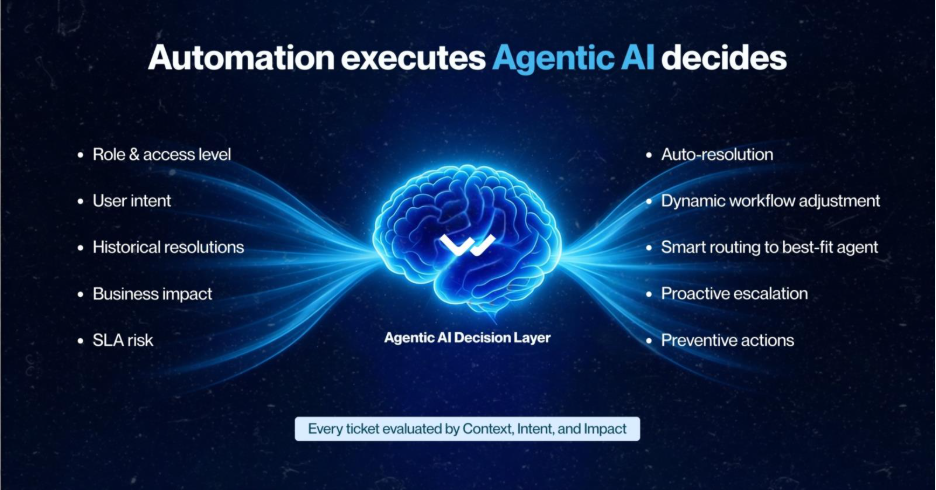
Agentic AI introduces an autonomous decision to layer into the helpdesk. Instead of waiting for predefined triggers, the system evaluates each request holistically. It considers who raised it, what they need, why they need it, which systems are involved, and how similar issues were resolved in the past.
Based on this understanding, the AI decides the best next action—resolving the issue instantly, dynamically adjusting the workflow, routing it to the right team, or escalating proactively. The helpdesk stops reacting to tickets and starts reasoning through them.
How Agentic AI Delivers Human-Like Decisions Automatically
Experienced human agents don’t follow scripts blindly. They read between the lines, recognize patterns, and adapt their response based on context. Agentic AI brings this same capability to automation.
By learning continuously from historical data, outcomes, and feedback, Agentic AI improves how it prioritizes requests, selects resolution paths, and prevents repeat issues. Over time, the system becomes more accurate and more efficient—without constant reconfiguration.
In real enterprise environments, this translates into fewer escalations, faster resolutions, and a noticeable reduction in repetitive work for agents.
What This Looks Like in Real Organizations
In fast-growing organizations supporting thousands of employees across regions, helpdesks are often flooded with repetitive requests such as password resets, VPN access, and software permissions. Before adopting Agentic AI, automation handles only the simplest cases. Anything slightly different lands in manual queues, driving up Mean Time to Resolution and frustrating users.
With Agentic AI in place, incoming requests are analyzed for intent, role, urgency, and risk. Low risk and repeat issues are resolved automatically. Access requests follow different approval paths depending on policy and context. High-impact incidents are routed to the right teams with full background, reducing back-and-forth. The number of tickets may remain high, but the human effort required to manage them drops significantly.
Why Industry Research Is Pointing in This Direction
This evolution mirrors how analysts describe the future of IT service management. Gartner has consistently highlighted the move toward autonomous, AI-driven service models where systems take proactive action instead of relying on human intervention for routine decisions.
Similarly, McKinsey & Company emphasizes that AI creates the most value when it goes beyond task automation and supports decision-making at scale. Their research shows that organizations applying advanced AI in service operations improve not only efficiency but also experience quality and operational resilience.
How to Start Automating with Agentic AI
To automate the helpdesk effectively with Agentic AI, organizations must rethink how automation is designed. Instead of defining every rule, they define policies and desired outcomes. Instead of locking workflows in place, they allow AI to adapt paths dynamically within clear guardrails.
Success is measured not just by speed, but by reduced repeat incidents, fewer escalations, lower agent workload, and more consistent service experiences.
The Future of Helpdesk Automation
The future helpdesk is not a faster ticket factory. It is an intelligent service layer that understands context, acts autonomously, and improves continuously. Agentic AI enables helpdesks to operate the way an experienced human would—making informed decisions in real time—while scaling volumes no human team could manage alone.
Automating the helpdesk with Agentic AI isn’t about removing people. It’s about letting intelligence handle the routine, so humans can focus on what truly requires human judgment.
At platforms like Wavity, this future is already taking shape. Wavity’s AI-native helpdesk uses Agentic AI to understand context, make real-time decisions, and automate resolutions across tickets and workflows—without locking teams into rigid rules. This allows organizations to scale support intelligently while preserving the human judgment that truly matters.
Ready to see this in action?
Book a demo with us and explore how Agentic AI can transform your helpdesk operations.