How AI-Powered ITSM Platforms Deliver Human-Level Support at Scale


For years, IT service management (ITSM) has been measured by speed: faster ticket routing, quicker responses, tighter SLAs. But speed alone has never equaled quality. What employees and customers expect is human-level support—support that understands context, remembers history, adapts to situations, and resolves problems without unnecessary back-and-forth.
Today, AI-powered ITSM platforms are finally closing that gap. Not by replacing humans, but by scaling human-like intelligence across thousands or millions of interactions—something traditional service desks could never achieve.
From Transactional Support to Human-Level Experiences
Traditional ITSM platforms were designed for transactions:
- Log a ticket
- Assign it to a queue
- Follow a predefined workflow
- Close the issue
This model breaks down on scale. As organizations grow, tickets multiply, environments become more complex, and users expect faster, more personalized support.
AI-powered ITSM platforms change the foundation entirely. Instead of treating tickets as isolated tasks, they treat each interaction as a decision moment, informed by context, history, and intent—much like a skilled human agent would.
What “Human-Level Support” Really Means in ITSM
Human-level support is not about conversational chatbots alone. It’s about judgment, prioritization, and learning.
AI-powered ITSM platforms deliver this through:
- Contextual understanding
AI analyzes who raised the request, their role, past issues, system dependencies, urgency, and business impact—before deciding what to do next.
- Intent-driven responses
Instead of reacting to keywords, AI understands why a request was raised: a simple query, a potential escalation, or a recurring problem.
- Adaptive decision-making
Just as an experienced agent adjusts their approach based on the situation, AI dynamically selects workflows, resolutions, or escalation paths.
- Continuous learning
Every resolved issue improves future decisions, creating compounding intelligence rather than static automation.
Real-World Example: Scaling Support Without Scaling Headcount
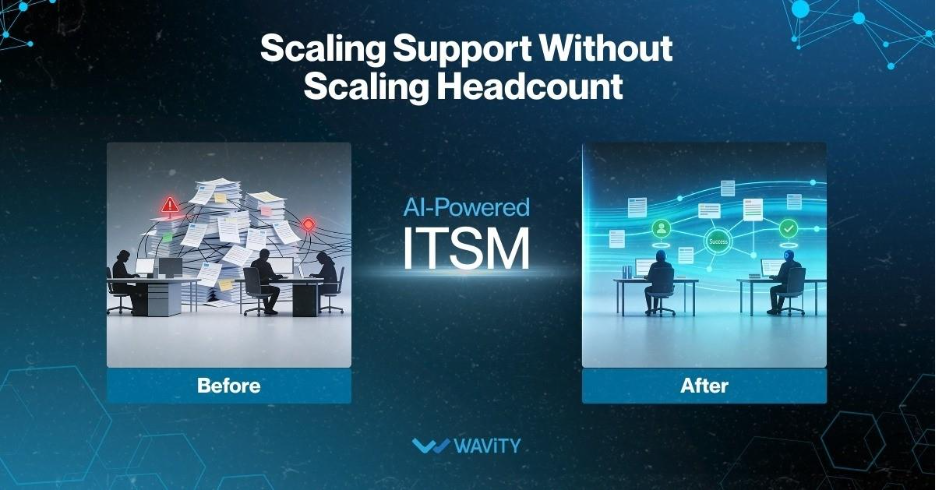
Consider a global enterprise with thousands of employees across regions and time zones.
Before AI-powered ITSM
- The service desk handled tens of thousands of tickets per month
- Repetitive issues (VPN access, password resets, software requests) consumed most agent time
- Escalations increased during peak periods, despite more hiring
After implementing an AI-powered ITSM platform
- AI automatically categorized and resolved a large percentage of recurring issues
- Context-aware routing ensured high-impact incidents reached the right teams instantly
- Employees received accurate resolutions on the first interaction, without repeating details
The result wasn’t just faster resolution—it was consistent; human-like support delivered at enterprise scale, without adding more agents.
Why This Shift Matters Now
Industry analysts have been clear about this transformation.
Gartner has repeatedly emphasized that the future of ITSM lies in AI-driven, autonomous service models that reduce human dependency for routine decisions while improving service quality.
Similarly, McKinsey & Company highlights that organizations adopting AI across service operations don’t just cut costs—they improve experience, resilience, and decision quality. Their research consistently shows that AI delivers the highest value when it augments human judgment at scale, not when it simply automates tasks.
In other words, the competitive advantage isn’t automation alone—it’s intelligence that behaves like a skilled human, everywhere at once.
How AI-Powered ITSM Achieves Scale Without Losing the Human Touch
Scaling human support traditionally meant one thing: more people. AI-powered ITSM platforms break that equation by embedding human-like reasoning directly into the system.
They achieve this by:
- Resolving common issues autonomously, 24/7
- Assisting agents with deep context instead of raw data
- Preventing incidents by learning from historical patterns
- Delivering consistent decisions regardless of volume or time
This ensures that whether the platform handles 100 tickets or 100,000, the quality of support doesn’t degrade.
The Future of ITSM: Intelligence as the Default
AI-powered ITSM platforms represent a fundamental shift—from reactive service desks to intelligent service ecosystems. They don’t just respond to problems; they anticipate, adapt, and improve continuously.
As expectations rise and IT environments grow more complex, human-level support at scale is no longer a luxury—it’s a necessity. Organizations that embrace AI-native ITSM now will be the ones delivering faster resolutions, better experiences, and real business value tomorrow.
The question is no longer whether AI belongs to ITSM.
It’s whether your ITSM platform is intelligent enough to scale out human judgment—without waiting for humans to catch up.
At platforms like Wavity, this shift is already underway. Built as an AI-native ITSM platform, Wavity uses Agentic AI to move beyond static workflows—enabling systems that understand context, make decisions, and act autonomously across tickets, workflows, and service operations. The result is not just faster resolution, but an ITSM experience designed to scale human judgment with consistency and control.